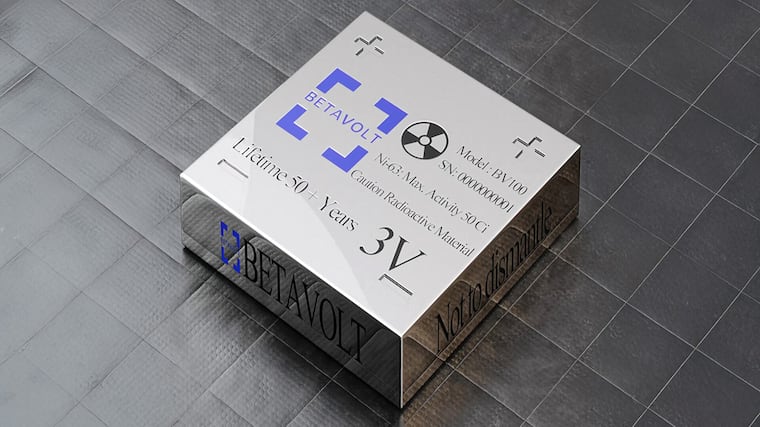
China has made a significant leap forward in nuclear battery technology with the introduction of an ultra-efficient prototype designed to power small electronic devices for decades. This innovative battery, developed by Northwest Normal University in Beijing in partnership with a Chinese technology company, marks a notable improvement over earlier models by dramatically reducing fuel consumption while boosting energy output.
The compact unit, measuring less than one cubic inch, operates with up to 22% less nuclear fuel than previous versions, reflecting a remarkable gain in efficiency. This advancement not only extends the potential lifespan of battery-powered devices but also opens new possibilities for applications requiring long-lasting, maintenance-free energy sources, such as medical implants and aerospace equipment.
Harnessing Nuclear Decay for Sustainable Power
At the core of this groundbreaking battery lies the principle of nuclear decay, a natural process in which radioactive substances gradually lose their radioactivity over time. The Chinese prototype utilizes carbon-14, a radioactive isotope with a notably long half-life, as its fuel. This choice underpins the device’s capability to generate stable power for extended periods, potentially spanning thousands of years.
China’s commitment to pioneering advancements in energy technologies, including renewables, electric vehicles, and nuclear power, is underscored by this development. By pushing the boundaries of nuclear battery design, the nation is positioning itself to lead in an emerging field that promises durable, efficient power solutions for a wide range of high-tech applications.
The introduction of this new carbon-14 nuclear battery prototype signals a future where devices reliant on compact, long-lasting energy sources may operate maintenance-free for decades, revolutionizing sectors that demand reliability and endurance from their power supplies.